Partnering among stakeholders has emerged as an essential tactic for improving operational efficiency in the clinical trials sector. Driven by escalating clinical trial timelines, more complex protocols, stalled patient enrollment, and rising costs, this global industry is evolving past traditional outsourcing toward various types of strategic partnerships and collaborations. Outsourcing remains standard practice for pharmaceutical sponsors looking to rein in costs and boost the bottom line, as currently, 20% - 55% of functions are outsourced, depending upon the market segment [1], with a value of $20 - $22 billion annually [2]. But stakeholders need more than what traditional outsourcing can offer. They are getting serious about collaborative efforts across multiple clinical trials, essentially putting skin in the game as they work to improve processes that address the industry’s toughest challenges.
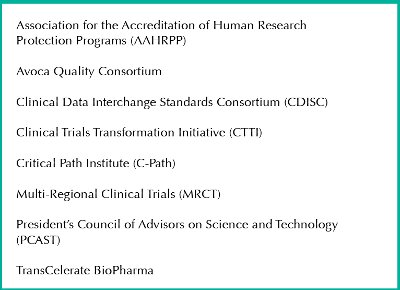
To get started, pharmaceutical sponsors have stepped up their collaborations with contract research organizations (CROs) [3-5], and have participated in a spate of initiatives (Figure 1). Generally, these efforts include sponsors, CROs, vendors, and representatives of government and academic institutions. TransCelerate BioPharma, for example, announced in April 2013 that six new pharmaceutical companies joined as members of this independent entity with a mission of speeding innovation [6]. But, by and large, these efforts have not included the investigative site the essential element of the whole process the place where clinical trials actually happen. This could be a serious oversight because as various initiatives craft solutions, they might propose action that impacts how sites conduct clinical trials without seeking their input and that may not be the most practical or efficient. Essentially, the site’s voice is not being heard, and at least to some degree, this might explain why deep-rooted problems persist.
This article describes how the fragmented research ecosystem and a lack of community among sites have long been major factors in their inability to have their voices heard, which ultimately has a negative impact on the entire industry. Without a unified voice, it has been difficult for other stakeholders to view sites as valued partners in the industry’s quest to improve clinical trial operations, even though collectively, sites represents the largest number of “vendors/partners” in the entire ecosystem.
Figure 1. Some Industry-Wide Initiatives to Improve Operational Efficiency
The Society for Clinical Research Sites (SCRS) was formed in October 2012 as the first global trade association dedicated to representing clinical research sites. SCRS is a natural outgrowth of the Site Solutions Summit, an annual gathering of site and industry stakeholders focused on discussing issues with the goal of building stronger relationships and helping to establish best site practices. SCRS leadership realized the importance of the global site landscape and is committed to ensuring representation of sites around the globe. In the six months since its inception, SCRS represents almost 1,000 sites in 12 different countries. Through SCRS, sites now have a community that can contribute to the development of solutions to challenges confronting so many players in the industry.
Why Partner With Sites?
Building relationships with sites is not a new idea. Tracey Gashi, Director of Global Strategic Site Collaborations for a major CRO, explains, “They play a central role. Without sites there would be no patients. Without patients, no data; and without data, no new medicines. It is, therefore, essential to have a close collaboration with sites to understand the challenges they face and to proactively address these.”
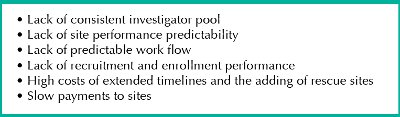
Improving clinical trial operations has become a concentrated focus in the industry, and sponsors and CROs are wrestling with how to address it at the site level. Most notably, there is a lack of a consistent investigator pool, lack of site performance predictability, lack of predictable workflow, and other key sticking points (Figure 2). The constant churning of the investigator pool is particularly acute, leaving the industry with fewer experienced investigators. A recent study from the Tufts Center for the Study of Drug Development cites an annual 40% turnover rate among FDA-regulated principal investigators (PIs) [7]. Annual turnover rates exceed 50% for investigators in the Asia Pacific region, Latin America and Europe. These alarming statistics are attributed not only to traditional challenges such as meeting patient enrollment targets and complying with good clinical practice (GCP), but also to onerous regulatory requirements leading to more complex protocols, arduous contract and budget negotiations, and difficulties receiving prompt payments.
Figure 2. Key Challenges Linked to Site Operations
As investigators quickly come and go, and with 53% of all FDAregulated clinical trials now conducted by independent, community-based PIs [7], the resulting fragmentation within the industry is a topic meriting lots of discussion, one in which the sites’ perspective is needed to provide a better understanding of why this is happening and offer solutions. Until this fundamental issue is addressed, and corrected, the cost of doing clinical research will continue to rise and the timelines will continue to expand. Conducting clinical research at the site is a very difficult task, one in which experience is a key factor in addressing the challenges experienced by the site. Without recognizing the importance of maintaining a solid investigator pool, the industry is left to pick up the pieces.
The value of including sites in this discussion and others has been well documented. Lamberti et al describe a 2010 survey in which 3,516 active investigators from across the globe were asked to rate their clinical trials experience with technology usage, training, site operations and budgets. They were also invited to rate companies in areas such as investigator payments, study protocol, and communications. The researchers found the key factors influencing an investigator’s willingness to participate in clinical trials were availability of qualified patients based on inclusion/ exclusion criteria, availability of information about the study, adequate payments, and recruitment support. Good communication with the CRO was also pegged as essential for successful site performance. [8]
An article dating back to the mid-1990s describes a survey in which sites and sponsors were asked to describe their frustrations with other stakeholders [9]. Specifically, sites point to lack of responsiveness and accessibility by CROs, monitor turnover, ineffective chain of communication, and poor study design. Sponsors and CROs faulted sites for being unprepared to meet contract deadlines, inadequately trained, lacking in commitment, and having difficult personalities. Solutions focused on team efforts, and improving communication and relationships. A spate of similar articles followed, notably some that stressed the importance of good relationships between sponsors/CROs and sites, and refer to “investigator relationship management” [10, 11].
Although the seeds to partner with sites have long been planted, it seems the industry has done little to nurture them, possibly because the sites lacked a central place for dialogue with stakeholders or an organized forum to voice their perspective prior to SCRS. Yet, even before the formation of SCRS, a number of forward thinking sponsors and CROs recognized the opportunity for sites to improve operations, and they have made it a priority to embrace site relationships as part of an overarching goal of reducing clinical trial timelines and costs.
Michael D. Jones, Senior Director Global Clinical Operations at Eli Lilly, says his company has a strong focus on building long term relationships with sites, a tactic that has allowed the organization to be successful. “Our view is that building strong relationships with sites provides everybody with a benefit and our approach is to treat the site as a partner rather than a provider,” Jones says.
Eli Lilly first began building relationships with sites in the late 1980s and early 1990s. It was a time when studies were simpler and largely conducted at academic medical centers. In 2008, the company renewed its interest in building strong site relationships because as Jones explains, “We were realizing that we weren’t necessarily getting the best sites to do our work.”
To make much needed changes, Jones and his team led an effort to build a department of 200, located across the globe, charged with identifying and evaluating the best sites for specific clinical trials. It is a data-driven process, and they do not stop there. “We have boots on the ground to identify, develop, and maintain relationships,” he says.
Since this 2008 initiative, the company has seen significant improvements in results linked to relationship building. “We’ve seen the proportion of sites that never enroll a single patient in Phase II and Phase III studies drop by more than 50%. It’s now in the single digits. Enrollment rates per site per month have improved across the portfolio, and with this improvement, we are shortening the period of enrollment. Also, median cycle times for site activation have decreased by 20% across the portfolio,” Jones explains.
Tracey Gashi comments that the old outsourcing model of CROs working with sites on a transaction-by-transaction basis is giving way to a strategic approach, whereby CROs seek to collaborate with sites on development programs to identify efficiencies at a program level rather than the level of the individual study. From the site’s perspective, “these relationships lead to an increased volume of commercial clinical trials, greater access to novel medicines for patients and the opportunity to contribute to their development by inputting to protocol design and conduct. They also provide sites with a transparent point of contact within our global business,” Gashi says.
Success is measured by improved study metrics and client and site satisfaction, and thus far, their strategic partnering efforts are demonstrating benefits. Gashi says the main business challenge is identifying sites that are able to address anticipated business needs over a multi-year period to ensure a flow of studies. The company maintains strategic partnerships with a number of key sponsors, and through these relationships, “we have a good understanding of the pipeline of trials that are likely to be outsourced. This allows us to proactively plan relationships with sites based on the anticipated business,” she adds.
This CRO has been innovative in building site partnerships, having earnestly started in this effort in 2009. Specifically, the company has a department dedicated to improving relationships with sites to increase the efficiency of delivering clinical research. Because of the global nature of clinical research, there is no defined relationship model; rather, the approach varies by region and according to business need.
About SCRS
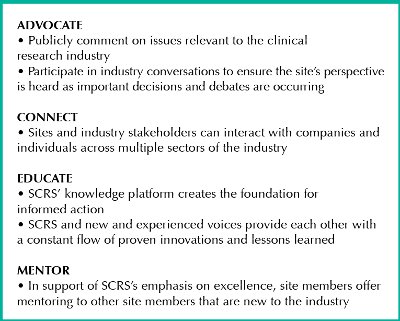
As sponsors and CROs boost their partnering initiatives with sites to improve operational efficiencies, they will likely gain a better understanding of sites’ issues. Helping in that endeavor is SCRS, with its mission of taking concrete steps to provide a voice to sites. These include advocating, connecting, educating, and mentoring (Figure 3).
The young trade organzation has become a board member of Clinical Trials Transformation Initiative (CTTI) and Metrics Champion Consortium. SCRS has also been invited to participate in various industry-wide meetings and discussions where the site’s perspective is being valued by inclusion in the dialogue. Some organizations reaching out to SCRS include Clinical Data Interchange Standards Consortium (CDISC) and Multi-Regional Clinical Trials (MRCT). Moreover, SCRS has already delivered presentations at global conferences and forward thinking sponsors/CRO and professional providers have joined SCRS as Global Impact Partners.
Figure 3. How the Society for Clinical Research Sites (SCRS) Provides a Voice
Embracing the Sites’ Perspective
As the clinical trials sector seeks to resolve issues ranging from enrollment challenges to overly complex protocols, it makes sense to invoke an all-hands-on-deck approach, meaning that all stakeholders need to be actively involved in crafting solutions. This includes sites, the most numerous participant in the increasingly global clinical trials enterprise, but the one that has been the most overlooked. Now, with a unified global voice in the form of SCRS, they can offer an experiencedbased perspective to proposed solutions to industry-wide challenges. And with this voice, sponsors, CROs, government agencies and regulators and others will have the opportunity to better appreciation how sites operate and how they can contribute to efforts to streamline the clinical trials process, benefiting all stakeholders.
References
- Martorelli MA. Pharmaceutical Outsourcing Monitor. 13 Questions for 2013. Fairmount Partners. January 29, 2013.
- Martorelli MA. Pharmaceutical Outsourcing Monitor. Reviewing and Previewing. Fairmount Partners. April 19, 2013.
- Taylor N. Strategic Partnerships With CROs Key to Patient Recruitment. Outsourcingpharma.com. August 31, 2010. Available at: http://www. outsourcing-pharma.com/Clinical-Development/Strategic-partnershipswith- CROs-key-to-patient-recruitment. Accessed April 23, 2013.
- Lipp E. CRO Relationships Get More Serious. Genetic Engineering & Biotechnology News. July 1, 2010;30(13). Available at: http:// www.genengnews.com/gen-articles/cro-relationships-get-moreserious/ 3346/?page=1. Accessed April 23, 2013.
- Strategic Partnerships 2013: Transforming and Unlocking Value in Biopharmaceutical Development. PAREXEL. 2013.
- Kumar S, Caudill S. TransCelerate BioPharma Inc. Grows, Strengthens Novel Effort to Accelerate Drug Development. PR Newsire. April 15, 2013. Available at: http://www. prnewswire.com/news-releases-test/transcelerate-biopharmainc- grows-strengthens-novel-effort-to-accelerate-drugdevelopment- 203007291.html. Accessed May 3, 2013.
- Kaitin KI. Optimizing Protocol Design to Improve Clinical Study Performance, Efficiency, and Cost. Tufts Center for the Study of Drug Development Impact Report. March/April 2013;15(2).
- Lamberti MJ, Zuckerman R, Howe D, Shapiro L, Getz KA.Factors Influencing Investigative Site Willingness and Ability to Participate in Clinical Trials Drug Information Journal May 2011;45:377-390
- Harper BD. The Effectiveness of Sponsor/CRO-Site Performance Incentives. The Monitor. Fall 1997, 9-18.
- Harper BD, Neuer A. Good Site and Sponsor Relationships Pay Off. Applied Clinical Trials. January 2008, 50-56. Available at: http://clinicalperformancepartners.com/wp-content/ uploads/2012/07/Good-Site-And-Sponsor-Relationships-Pay-Off. pdf. Accessed April 20, 2013.
- Meyerson L, Blumenfeld T. Rethinking the Sponsor-Investigator Relationship. PharmaExec.com. January 6, 2009. Available at: http://www.pharmexec.com/pharmexec/article/articleDetail. jsp?id=574030. Accessed April 26, 2013.
Christine Pierre is the Founder and President of the Society for Clinical Research Sites (SCRS), and the CEO and Founder of RxTrials, Inc. She is internationally known for her experience and expertise in clinical research site management and patient recruitment and retention for the clinical trials industry. Ms. Pierre has served as Chairman of the Board of the Association of Clinical Research Professionals (ACRP) and has served on numerous editorial boards of industry publications. Ms. Pierre can be reached at myscrs.org or 410-496-5080 ext. 120.