Why the Model Matters
Determining the right dose for a drug means knowing what the body will do to the compound, and what the compound will do in the body, before anyone takes it. That is the job of preclinical ADME testing: absorption, distribution, metabolism, and excretion. Carried out during lead optimization and preclinical testing, ADME studies are used to inform the clinical phases of development, which account for most of a program’s cost (Figure 1). Calculating dosage requires striking a careful balance between efficacy and toxicity, which is part of why toxicity still accounts for roughly 30% of clinical failures1. Drug toxicity, however, does not paint the entire picture. In an analysis of candidates from four major pharmaceutical companies, pharmacokinetics and bioavailability were ranked as the third most common reason for Phase I attrition2, and both continue to challenge development today, directly influencing therapeutic efficacy and program progression3,4. Drug developers also need to consider the patient variable, since genetic differences in drug-metabolizing enzymes mean the same dose can produce very different exposure across a population. When models are asked to answer these complex questions beyond their strengths, the result is misplaced confidence and costly failures that emerge too late.
ADME predictions are only as good as the models behind them, and all models have strengths and limitations. Simple in vitro assays measure one process in isolation. In silico predictions depend on the quality of the in vitro and in vivo data fed into them and exist in part to compensate for the shortfall those inputs leave behind. Animal models do not accurately recapitulate several aspects of human physiology, and these differences lead to variations in drug behaviors across species. Each contributes useful evidence, but what is missing is the connected human biology needed to predict ADME behavior with confidence.
Regulatory policy increasingly reflects this. The FDA Modernization Act 2.0, passed in 20225, eliminated the blanket requirement for animal testing and recognized alternatives, including organ-on-a-chip systems and computer models, as acceptable evidence of a drug’s safety and effectiveness. The UK went further on pharmacokinetics, setting a target in its 2025 roadmap to cut the use of dogs and non-human primates in dedicated PK studies for human medicines by at least 35% by 20306. For drug developers, the practical task is choosing the tool, or combination of tools, that best answers each ADME question.
The Limits of Animal Data
Oral bioavailability is where the gap is most evident. In a review of 184 compounds combining animal and human data, oral bioavailability in the usual preclinical species tracked human values poorly, with mouse giving a correlation (R2) of 0.25, rat 0.28, and dog 0.377. Non-human primates performed better at 0.69, but cost and ethical concerns limit their use. Species differ in gut physiology and metabolic capacity, and the enzymes that break drugs down function at different levels or are missing. Therefore, animal pharmacokinetic data alone cannot be relied upon to predict human exposure or set a first-in-human dose.
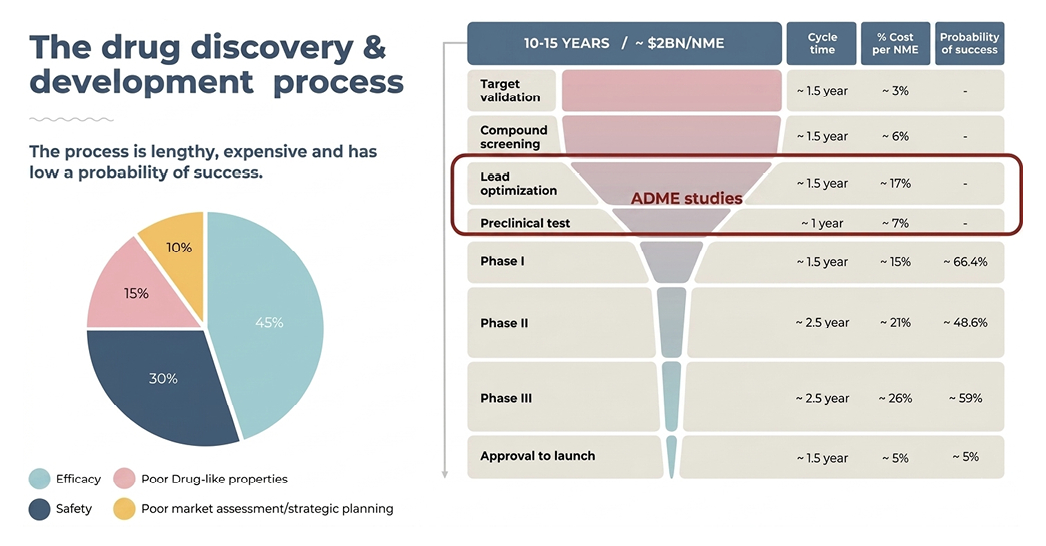
Figure 1. Where ADME studies sit in drug development. Taking a new molecular entity to launch takes 10 to 15 years and costs in the region of $2 billion. ADME work falls within lead optimization and preclinical testing, which together account for about a quarter of that cost. Adapted from Sun et al., 2022.
Bioavailability is hard to predict because it sits at the end of a connected biological chain: a drug crosses the gut wall, survives metabolism inside that wall, then survives first-pass liver metabolism before reaching circulation (Figure 2). Standard in vitro workflows break this chain into separate assays: a Caco-2 monolayer for permeability, microsomes or suspended hepatocytes for clearance, but none show how the steps interact. A compound can look well absorbed in a permeability assay and stable in an isolated liver assay yet still lose much of its dose when gut-wall metabolism, transporter activity, and first-pass liver clearance act together in sequence.
Modeling Human First-Pass Metabolism in vitro
Losses that happen in sequence should be measured in sequence, which is what a microphysiological system (MPS) is built to do. In the case of modelling first-pass metabolism, models combine primary human jejunum and hepatocytes, cultured in two linked compartments with media flowing between them. This connection enables researchers to study a compound through absorption and metabolism in the gut before passing on to the liver, recreating first-pass metabolism in a human-relevant setting (Figure 3).
In a 2025 study, this gut/liver setup estimated the oral bioavailability of midazolam at 0.478. Across 36 human studies, midazolam sits at a mean of about 0.31 to 0.33, with a spread from 0.096 to 0.68, placing the estimate within the human range. An alternative model, built using Caco-2 cell lines in place of human jejunum, estimated the oral bioavailability of midazolam at 0.68, demonstrating the crucial importance of optimizing model design and the considerations that need to be made when choosing cell types.
Additional value comes from comparing simulated oral dosing in the gut/liver model with intravenous dosing in a liver-only model, allowing a better understanding of the contributions of each organ. Oral bioavailability combines several measurements, which together show where loss occurs (Figure 4). Once again, model design is a key consideration here. In this case, data from the primary gut model pointed to gut metabolism through the enzyme CYP3A4. In contrast, the alternative Caco-2 model showed no CYP3A4 activity, which was linked to limited expression of the enzyme from the chosen cell line.
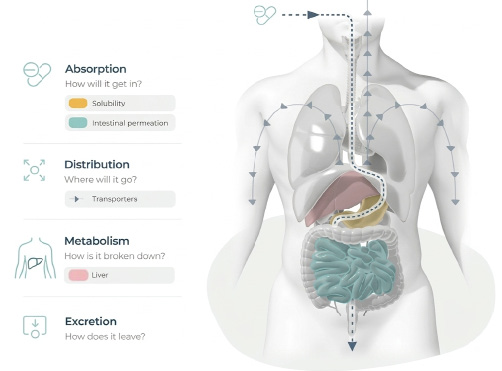
Figure 2. The four ADME processes and what each one determines. Absorption depends on solubility and permeation across the intestinal epithelium, distribution on the transporters that move a compound into tissues, metabolism largely on the liver, and excretion on the routes that clear the compound and its metabolites. Oral bioavailability is settled at the front of this sequence, where the gut wall and the liver act in succession on whatever crosses.
This fraction-by-fraction view from a single experiment helps developers understand why bioavailability is low and what to fix next, since poor absorption points to a different decision than high gut-wall or liver metabolism. Data from the MPS can subsequently be fed into computational models, which can be used to derive ADME parameters including intrinsic clearances and the fraction values. These models can then be used to feed PBPK modeling, which helps set a first-in-human dose. The FDA’s 2025 roadmap on reducing animal testing supports this directly, noting that the agency may review PBPK simulations to inform first-in-human dosing and to justify waiving animal studies that would otherwise be required⁹.
When ADME Questions Depend on Connected Biology
Prodrug activation and drug-drug interactions (DDI) both depend on intestinal and hepatic processes working together. As an example, the drug mycophenolate mofetil is inactive until an ester bond is cleaved to release the active drug, and that cleavage happens in both organs. Data from a Caco-2/liver MPS showed that the prodrug converted rapidly on the gut side, and the active drug and its glucuronide appeared in both compartments. The model also detected active transport pushing drug back out of the gut cells, with an efflux ratio above 1, consistent with P-glycoprotein and MRP210. In one experiment, the system captured absorption, activation, transport, and the gut-versus-liver contribution.
Because co-administered drugs can inhibit or induce those same enzymes and transporters, this connected readout also informs DDI risk. Ritonavir-boosted darunavir shows the point directly: ritonavir inhibits CYP3A-mediated clearance to raise darunavir exposure, while darunavir must be taken with food to absorb properly. Preliminary gut/liver MPS data show ritonavir’s poor absorption alongside its inhibition of CYP3A activity, and how absorption, metabolism, and enzyme inhibition combine to influence exposure. As intestinal CYP activity is often missed by conventional interaction models11, resolving gut and liver contributions separately adds value.
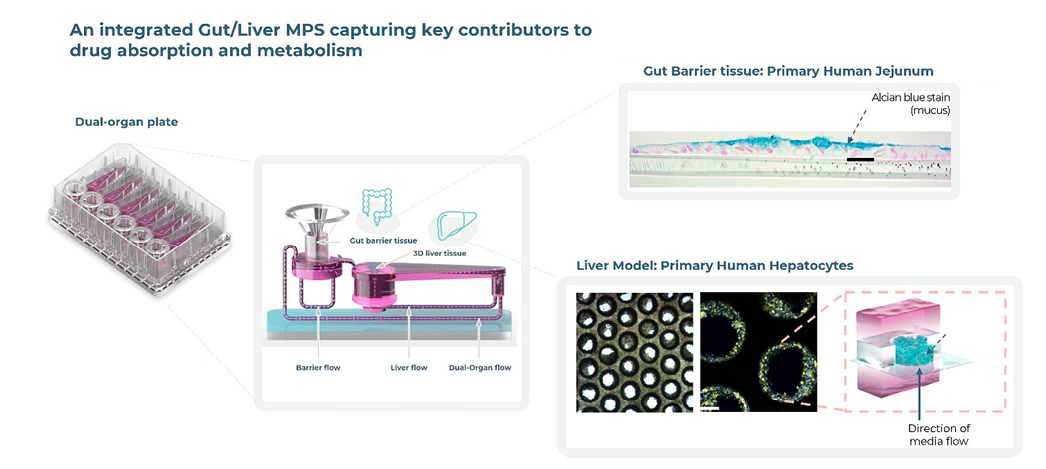
Figure 3. An integrated gut/liver microphysiological system. Primary human jejunum forms a barrier tissue with a mucus layer, on a permeable membrane above a three-dimensional tissue of primary human hepatocytes held in a perfused scaffold. Three flow paths run through the dual-organ plate: across the gut barrier, through the liver compartment, and between the two, such that a compound dosed on the gut side meets absorption, gut-wall metabolism, and first-pass liver metabolism in sequence.
Population variability further complicates ADME studies, since people carry different versions of the enzymes that metabolize drugs. CYP2D6, which handles many medicines, is among the most variable12. Dextromethorphan is a standard CYP2D6 probe, and the spread is wide: oral bioavailability sits at roughly 1% to 2% in extensive metabolizers and around 80% in poor metabolizers13. Unlike pooled donor hepatocyte assays, which average out interindividual differences, a donor-based MPS shows how high, intermediate, and low CYP2D6 activity alters bioavailability, and where the difference originates.
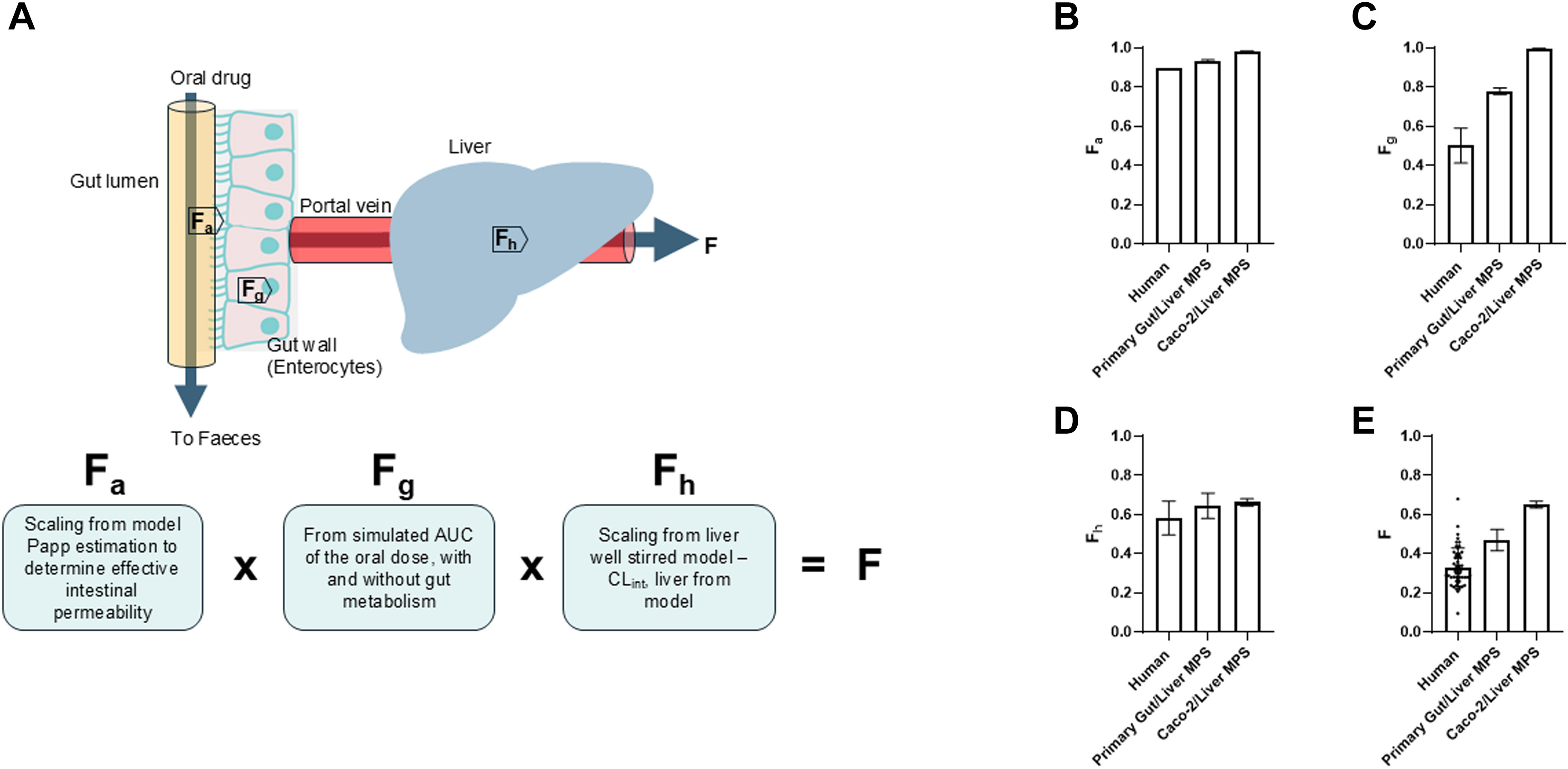
Figure 4. Bioavailability resolved into its components for midazolam. F is the product of the fraction absorbed into the enterocytes (Fa), the fraction escaping gut-wall metabolism and reaching the portal vein (Fg), and the fraction surviving passage through the liver (Fh), shown schematically in (A). (B-E) Comparison of the values derived from the primary gut/liver MPS and a Caco-2/liver comparator against human estimates. The two systems agree on Fa and Fh and separate on Fg, where the Caco-2 comparator records no gut-wall loss at all. Reproduced from Abbas et al., 2025.
In preliminary data from three human donors selected to reflect human diversity, the gut/liver assay predicted different oral bioavailability for each, in line with their CYP2D6 differences, and measured a gut metabolism contribution that models normally assume. A PBPK model assembles variability from the outside using enzyme abundance and scaling factors, whereas a donor-based system measures it directly and shows where it comes from, giving PBPK models mechanistic input and flagging which phenotypes may carry higher exposure risk.
Oligonucleotides and the Delivery Question
Some drug classes make the case for human-relevant models on their own, and oligonucleotides are the sharpest example. These short strands of nucleic acid are designed to bind a specific RNA sequence, and they break the assumptions that small-molecule ADME rests on, since whether one works safely depends on delivery biology as much as on how much drug reaches the blood.
An oligonucleotide adds questions the typical steps of an ADME workflow do not cover, for example whether the right receptor takes it up, whether it reaches and enters the target cell, and whether it engages and knocks down its target. Animal data can lose its footing at several of these points, because sequences, receptors, immune recognition, and tissue handling all differ between species.
Human organ models are well suited to studying delivery, as work on GalNAc shows. The sugar tag targets an oligonucleotide to the liver by binding the asialoglycoprotein receptor on hepatocytes. In a co-culture liver MPS of hepatocytes and Kupffer cells, a GalNAc-conjugated antisense oligonucleotide was taken up faster and in greater quantities during the first hour than the same oligonucleotide without the tag14. That looks like a clean win for conjugation, until the time course is followed out: the unconjugated version kept accumulating and overtook the conjugated one as the receptor-driven route saturated. Subsequent knockdown studies made the same point, since the strand taken up in greater quantity was not the one that produced more robust knockdown. What decided the effect was delivery to the liver cell type of interest, producing functional activity.
Human models are particularly valuable when uptake must be distinguished from efficacy and toxicity. In one study, conflicting toxicity findings from animal and two-dimensional systems left the human relevance of two antisense oligonucleotides unclear. Assessment in a human liver MPS, using alanine aminotransferase (ALT) release alongside CYP3A4 activity, differentiated the toxic oligonucleotide from the one that showed no evidence of toxicity under the study conditions15.
What an MPS Approach Can and Cannot Do
The value of MPS is in capturing human biological processes that conventional models simplify or miss. Human cells remove the species gap, which is vital as metabolic routes differ between humans and animals, and metabolites that count in people can be under-represented or absent in animal studies. Liver MPS has been used to explain metabolites that surfaced only in human trials. A co-publication with the FDA’s Center for Drug Evaluation and Research found data from a human liver MPS fit for drug safety, accumulation, and metabolism work16, and the approach now extends to new modalities such as oligonucleotides, where animals are less suited.
Depth of data is the second draw, since deriving fraction measurements and intrinsic clearances experimentally gives PBPK models measured inputs instead of assumptions to inform bioavailability predictions, DDI risk, and dosing strategy. Liver tissues that stay functional for weeks rather than days16 make slower clearance and repeat dosing observable, which matters for metabolic inducers, where longevity has enabled multi-dosing studies. Additional organ models, such as the kidney, will extend these systems to renal excretion, while harder ADME behaviors, including those of beyond-rule-of-five compounds, will define where MPS adds value and where its limits sit.
None of this makes MPS a replacement for a whole organism, and it is not meant to be. Its value is as a mechanistic tool that lowers the risk of costly late-stage failures in development programs. Used early, it can flag toxicity risk and identify which biology drives exposure and variability, with that understanding feeding PBPK modeling to progress the right candidates into animal or clinical studies. No single preclinical method is fully predictive, so the aim is to combine MPS with traditional approaches and in silico tools to capture the biology conventional models miss. Regulators are already moving in that direction, which leaves developers to work out, case by case, which combination answers the question in front of them.
References
- Sun D, et al. Why 90% of clinical drug development fails and how to improve it? Acta Pharmaceutica Sinica B. 2022;12(7):3049-3062.
- Waring MJ, et al. An analysis of the attrition of drug candidates from four major pharmaceutical companies. Nature Reviews Drug Discovery. 2015;14(7):475-486.
- Stielow M, Witczyńska A, Kubryń N, Fijałkowski Ł, Nowaczyk J, Nowaczyk A. The bioavailability of drugs: the current state of knowledge. Molecules. 2023;28(24):8038. doi:10.3390/molecules28248038
- Wu K, Kwon SH, Zhou X, Fuller C, Wang X, Vadgama J, Wu Y. Overcoming challenges in small-molecule drug bioavailability: a review of key factors and approaches. International Journal of Molecular Sciences. 2024;25(23):13121. doi:10.3390/ijms252313121
- Library of Congress. S.5002 - 117th Congress (2021-2022): FDA Modernization Act 2.0. Available at: https://www.congress.gov/bill/117th-congress/senate-bill/5002
- Gov.UK. Animal testing to be phased out faster as UK unveils roadmap for alternative methods. Available at: https://www.gov.uk/government/news/animal-testing-to-be-phased-out-faster-as-uk-unveils-roadmap-for-alternative-methods
- Musther H, Olivares-Morales A, Hatley OJD, Liu B, Rostami-Hodjegan A. Animal versus human oral drug bioavailability: do they correlate? European Journal of Pharmaceutical Sciences. 2014;57(1):280-291. doi:10.1016/j.ejps.2013.08.018
- Abbas Y, van Wyk M, Sze H, Christophi J, Spreen AA, Bliton RJ, Boazak EM, Kostrzewski T. A primary human Gut/Liver microphysiological system to estimate human oral bioavailability. Drug Metabolism and Disposition. 2025;53:100130. doi:10.1016/j.dmd.2025.100130
- FDA (U.S. Food and Drug Administration). Roadmap to Reducing Animal Testing in Preclinical Safety Studies. Available at: https://www.fda.gov/media/186092/download
- Milani N, Parrott N, Ortiz Franyuti D, Godoy P, Galetin A, Gertz M, Fowler S. Application of a gut-liver-on-a-chip device and mechanistic modelling to the quantitative in vitro pharmacokinetic study of mycophenolate mofetil. Lab on a Chip. 2022;22(15):2853-2868. doi:10.1039/d2lc00276k
- Galetin A, Gertz M, Houston JB. Contribution of intestinal cytochrome P450-mediated metabolism to drug-drug inhibition and induction interactions. Drug Metabolism and Pharmacokinetics. 2010;25(1):28-47.
- Grzegorzewski J, Brandhorst J, König M. Physiologically based pharmacokinetic (PBPK) modeling of the role of CYP2D6 polymorphism for metabolic phenotyping with dextromethorphan. Frontiers in Pharmacology. 2022;13:1029073. doi:10.3389/fphar.2022.1029073
- Rüdesheim S, et al. Physiologically-based pharmacokinetic modeling of dextromethorphan to investigate interindividual variability within CYP2D6 activity score groups. CPT: Pharmacometrics & Systems Pharmacology. 2022;11(4):494-511. doi:10.1002/psp4.12776
- Majer J, Alex A, Shi J, Chaney EJ, Mukherjee P, Spillman DR Jr, Marjanovic M, Newman CF, Groseclose RM, Watson PD, Boppart SA, Hood SR. Multimodal imaging of a liver-on-a-chip model using labelled and label-free optical microscopy techniques. Lab on a Chip. 2024;24(19):4594-4608. doi:10.1039/d4lc00504j
- Sewing S, Boess F, Moisan A, et al. Establishment of a predictive in vitro assay for assessment of the hepatotoxic potential of oligonucleotide drugs. PLoS ONE. 2016;11(7):e0159431. doi:10.1371/journal.pone.0159431
- Rubiano A, Indapurkar A, Yokosawa R, Miedzik A, Rosenzweig B, Arefin A, Moulin CM, Dame K, Hartman N, Volpe DA, Matta MK, Hughes DJ, Strauss DG, Kostrzewski T, Ribeiro AJS. Characterizing the reproducibility in using a liver microphysiological system for assaying drug toxicity, metabolism, and accumulation. Clinical and Translational Science. 2021;14(3):1049-1061. doi:10.1111/cts.12969
About the Author
Dr. Yassen Abbas is Biology Group Leader at CN Bio, where he helps advance Organ-on-a-Chip applications spanning ADME, oral bioavailability, computational modelling and emerging therapeutic areas. His background includes the European Space Agency and research positions at the University of Cambridge.